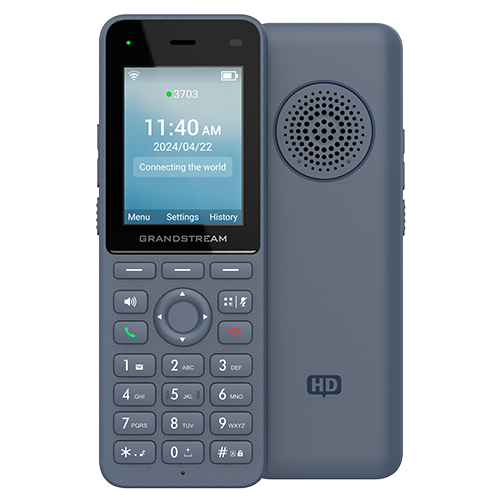
Documented specifications
Grandstream · Grandstream maintained a current product page, WP8x6 documentation updated in 2026, firmware listings and compliance resources at review. The general firmware table listed 1.0.3.35 and a separate 1.0.3.39 beta channel. Regional availability, exact shipped hardware, remaining support, installed firmware and acceptance remain deployment evidence.
| Specification | Documented value |
|---|---|
| SIP and conference controls | 3 SIP accounts and 3 lines; current product and datasheet say five-way conference while current user and quick-install material say four-way, so the installed release and tested workflow govern Source ↗ |
| Display and controls | 2.8-inch 240 × 320 colour display, physical call keys, customizable side key, accelerometer, proximity sensor and vibration Source ↗ |
| Wi-Fi | Dual-band Wi-Fi 6, 2T2R and 802.11k/r/v support; a measured handoff requires WLAN and endpoint evidence Source ↗ |
| Bluetooth and USB | Integrated Bluetooth 5.4 and USB-C charging; exact headset call control and PTT compatibility require named-accessory evidence Source ↗ |
| Battery | 3000 mAh; datasheet and user guide list 10 hours talk and 240 hours standby as laboratory data, while the quick guide says 200 hours standby Source ↗ |
| Environmental claims | Datasheet lists IP67 and IP69K plus chemical-resistant and antibacterial casing; the product-page comparison lists IP67 while surrounding copy says IP69K Source ↗ |
| Alarm capabilities | Push-button, man-down, no-movement, running and ambient-sound monitoring with configurable warning, snooze and optional automatic call behavior Source ↗ |
| Firmware-page observation | Grandstream listed 1.0.3.35 as general and 1.0.3.39 as beta on October 14, 2026; neither proves the build installed or approved on a particular handset Source ↗ |
Unlisted fields remain unverified. Platform compatibility and remaining support life require confirmation for the exact ordered model.
Preserve the current manufacturer conflicts
The current product page and datasheet describe five-way conferencing, while the shared user guide and September 2026 quick guide say four-way. The datasheet carries both IP67 and IP69K, while the product comparison lists IP67 and nearby marketing copy says IP69K. The datasheet and user guide list 240 hours standby, but the quick guide says 200. Do not choose the larger figure or silently average them.
Freeze the exact device label, hardware revision, running firmware, document revision and required workflow. Confirm the intended capacity and environmental standard with Grandstream or the authorized channel, then record the answer in the acceptance file. A successful ad hoc test does not rewrite the published specification.
Build the alarm as an end-to-end operational chain
Grandstream documents push-button, ambient-sound, no-movement, man-down and running alarms, including sensitivity, timeout, warning and snooze controls. It also documents an optional automatic call using a selected account and number. Each detector, warning, cancellation, call attempt, destination answer, identity, location, acknowledgement and response is a separate stage.
Pilot realistic posture and motion, ordinary loud work, device carried or left charging, low battery, lost WLAN, failed registration and unreachable destinations. Record false-positive and false-negative handling. A sensor trigger or outgoing SIP call is not proof of a certified lone-worker system or completed assistance.
Bound water, dust, chemical and antimicrobial claims
The manufacturer publishes IP67 and IP69K language, a two-metre drop claim, cleaning-chemical resistance and antibacterial or antimicrobial casing statements. Those claims do not establish protection after seal damage, every detergent or concentration, every impact orientation, high-temperature washdown, infection-control compliance or continued performance over the product life.
Obtain the exact test and cleaning instructions for the ordered unit. Define inspection, cleaning, battery-door and seal checks, damage quarantine and replacement. Preserve marketing language as manufacturer evidence rather than converting it into a medical, workplace-safety or durability guarantee.
Prove roaming and protected calling on the real WLAN
Dual-band Wi-Fi 6, 2T2R and 802.11k/r/v are documented capabilities, not a site survey or measured voice result. Record SSID, band, BSSID, channel, authentication, certificate, VLAN, address, DNS, time, SIP transport and media policy. Walk every required transition while preserving AP handoff, registration, RTP and audible evidence.
The datasheet lists TLS, SDES-SRTP and DTLS-SRTP alongside 802.1X, SCEP, OpenVPN and WireGuard capabilities. Enabled settings and negotiated call state remain separate. Do not describe a protected Wi-Fi association or VPN as proof that every signaling and media leg is protected.
Control firmware, provisioning and default access
At review, Grandstream listed 1.0.3.35 as general firmware and 1.0.3.39 as beta. A larger beta number is not a production recommendation. The administration guide identifies the program version as the main software release and supports official manual upload plus several provisioning methods. Select one effective configuration owner and preserve backup, approval and rollback evidence.
The quick guide documents a factory WLAN profile and a random administrator password on the label. Treat factory access as onboarding material, not a production configuration. Remove or replace unintended defaults, protect device labels and configuration exports, restrict administration and confirm that provisioning, certificates, accounts, alarm settings and keys persist after an approved update.
Accept voice, alarms and emergency access separately
Test cold boot, provisioning, WLAN join, roaming, registration, inbound and outbound identity, two-way audio, speaker, approved headset, hold, transfer, conference size, PTT, every enabled alarm, warning and cancellation, receiving workflow, charging, representative battery duty, restart and network recovery. Preserve ordinary calls and alarm calls as distinct results.
Grandstream states that the WP836 is not preconfigured to provide access to emergency services and requires additional arrangements. Use the provider-approved validation process, retain an independent route and train users on coverage and failure limits. No WP836, enclosure, sensor, alarm, WLAN, battery, accessory, firmware, PBX, responder path, emergency call, availability, compatibility, price, audio result or live call was inspected or tested for this reference.
Sources & applicability
Primary references for the technical details above. Operational examples and planning checklists are VoIP.info editorial guidance.
- Grandstream WP836 product page ↗
- Grandstream WP836 datasheet ↗
- Grandstream WP816, WP826 and WP836 user guide ↗
- Grandstream WP816, WP826 and WP836 administration guide ↗
- Grandstream WP836 quick installation guide ↗
- Grandstream firmware listings ↗
- Grandstream compliance resources ↗
Examples require adaptation to your topology. No live PBX or hardware testing is claimed.