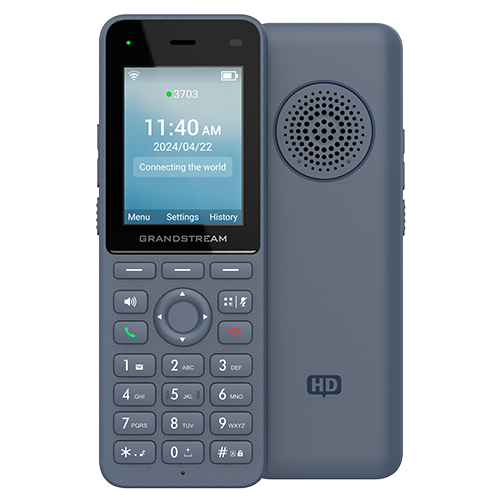
Documented specifications
Grandstream · Grandstream maintained a live product page, current documentation and a WP856 firmware listing at review. Android, Google certification, firmware, regional availability, package contents and support lifecycle can change independently.
| Specification | Documented value |
|---|---|
| SIP identities | Up to 6 SIP accounts and 6 lines; configured identities are not measured simultaneous-call or call-start capacity Source ↗ |
| Platform | Android 13, Google Mobile Services certification, Google Play access and custom Android application support Source ↗ |
| Display | 5.5-inch HD capacitive multi-touch screen with 2.5D third-generation Corning glass Source ↗ |
| Wi-Fi | Integrated dual-band Wi-Fi 6 (802.11a/b/g/n/ac/ax) with roaming support; installed WLAN design and roaming results remain separate Source ↗ |
| Bluetooth and NFC | Bluetooth 5.2 with BLE and NFC are documented capabilities; accessory and application behavior require exact-version acceptance Source ↗ |
| Data capture | Built-in 1D and 2D barcode scanner plus a 13 MP rear camera; symbology, workflow, accuracy and data handling require application-level validation Source ↗ |
| Battery | Replaceable 5000 mAh battery; manufacturer maxima of 20 hours talk and 200 hours standby, not an installed-workload result Source ↗ |
| Ruggedization | IP65-rated enclosure and manufacturer drop-safe rating up to 1.5 m onto concrete; this does not establish survival of every impact, chemical or deployment environment Source ↗ |
| Current firmware listing | Grandstream listed 1.0.3.16_GS_207.0.3.16 at review; the listing is not evidence of the installed or approved build Source ↗ |
Unlisted fields remain unverified. Platform compatibility and remaining support life require confirmation for the exact ordered model.
Treat it as a managed computer and a phone
The WP856 combines Android 13, Google Mobile Services, Google Play, custom applications and SIP telephony. Record who owns device enrollment, Google identity, application allow-list, permissions, updates, wipe and reassignment. A SIP registration does not prove that the approved application is installed, and a successful application login does not prove inbound calling or two-way media.
Keep the firmware, Android build, Google components, installed applications and application data as separate version and governance records. Confirm current lifecycle and enterprise controls before purchase; a product page saying Android 13 is not a promise of a future Android upgrade.
Engineer Wi-Fi and roaming for the real workflow
Grandstream documents dual-band Wi-Fi 6 and roaming support, but a supported standard is not a completed WLAN design. Map bands, channels, security, authentication, voice QoS, minimum signal and capacity for the intended warehouse, retail, healthcare or security route. Test association, reauthentication and handoff while walking the actual path under representative load.
Preserve SIP signaling, RTP, scanner transaction and application-session behavior through each roam. A Wi-Fi icon, low ping or uninterrupted data session does not establish intelligible audio, continuous scanning or recovery after a missed handoff.
Validate scanner, NFC and camera as data systems
The built-in scanner supports 1D and 2D workflows, while NFC and a rear camera add further capture paths. Define approved symbologies, application ownership, validation, duplicate handling, offline queueing, retry, audit and error correction. A readable test barcode does not establish accuracy, authorization or correct inventory posting.
Minimize permissions and retained data. Treat captured identifiers, images, NFC contents and diagnostic exports according to the organization's privacy and security policy. Disable or restrict unused capture methods rather than assuming the voice configuration governs them.
Keep published durability and battery figures bounded
The data sheet lists IP65 protection, a drop-safe rating up to 1.5 metres onto concrete and a replaceable 5000 mAh battery with up to 20 hours talk and 200 hours standby. These are manufacturer conditions and maxima, not observed endurance, chemical-cleaning compatibility or impact survival in one environment.
Pilot representative brightness, Wi-Fi, roaming, scanner, camera, Bluetooth, application and calling load. Record charging temperature, shift length, battery age, replacement and spare-charging workflow. Confirm the regional package and charger rather than inferring contents from another market.
Separate accounts, calls and conferencing resources
The published six SIP accounts and six lines describe configured identities and appearances. They do not establish six simultaneous calls, six active media streams, call-start rate, PBX allowance or Wi-Fi capacity. Define the intended account, number, caller identity, voicemail, push-to-talk and conference workflow, then retain actual offer, answer and media evidence.
The data sheet lists codecs and TLS and SRTP capabilities. Capability does not prove negotiated codec, trusted certificates, protected signaling, protected media or end-to-end encryption. Inspect every active leg and apply the organization's certificate and key policy.
Pilot the complete mobile-work and recovery path
On the exact approved firmware and application set, test cold boot, enrollment, WLAN join, roam, SIP registration, inbound and outbound calls, hold, transfer, speaker, headset, scanning, NFC, camera, application commit, offline recovery, update, restart, battery change and loss and restoration of network. Keep Bluetooth, USB, application and voice outcomes separate.
Use provider-approved emergency validation and preserve the correct number and physical-location workflow for a mobile Wi-Fi endpoint. No WP856, package, WLAN, roam, SIP account, Android app, Google service, scanner, barcode, NFC tag, camera, accessory, battery, firmware, management path, protected session, emergency route, availability, compatibility, price, audio, video or call was inspected or tested for this reference.
Separate rugged voice handsets from mobile computing
The rugged Wi-Fi handset category keeps the WP856 Android, scanner, NFC and application estate distinct from voice-first models such as the WP836. Similar Wi-Fi and enclosure labels do not create the same privacy, update or acceptance scope.
Sources & applicability
Primary references for the technical details above. Operational examples and planning checklists are VoIP.info editorial guidance.
- Grandstream WP856 product page ↗
- Grandstream WP856 user guide ↗
- Grandstream WP856 administration guide ↗
- Grandstream WP856 data sheet ↗
- Grandstream firmware listings ↗
- Grandstream WP836 product page ↗
- Grandstream WP836 datasheet ↗
- Grandstream WP816, WP826 and WP836 user guide ↗
- Grandstream WP816, WP826 and WP836 administration guide ↗
- Grandstream WP836 quick installation guide ↗
- Grandstream compliance resources ↗
Examples require adaptation to your topology. No live PBX or hardware testing is claimed.