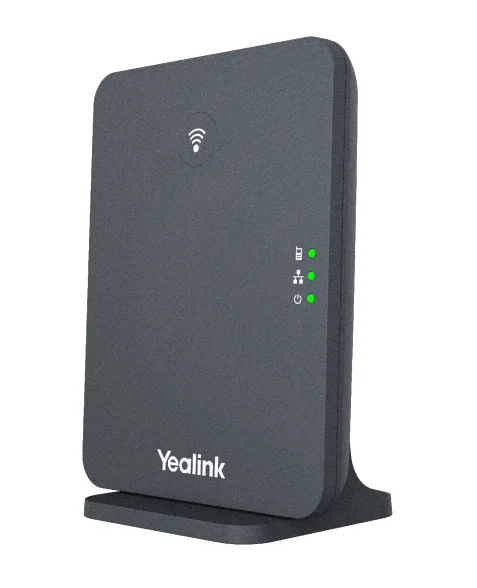
Documented specifications
Yealink · Yealink presented CP935W-Base and W70B on current product or support pages at review. Exact regional package, radio band, availability, hardware revisions, approved firmware pair, service certification, warranty entitlement and remaining support period were not established.
| Specification | Documented value |
|---|---|
| System roles | CP935W is the DECT endpoint; the included W70B owns Ethernet, SIP-account placement and the single-cell radio path Source ↗ |
| Package | Datasheet package lists CP935W, charging cradle, W70B, base stand, two power adapters and Ethernet cable Source ↗ |
| Endpoint account boundary | W70B supports up to 10 SIP accounts, while the CP935W endpoint is documented with one SIP account Source ↗ |
| System call boundary | W70B publishes up to 20 simultaneous calls; the CP935W publishes a 5-way local conference Source ↗ |
| Radio topology | W70B is a single-cell system; roaming and handover are not listed for that topology Source ↗ |
| Published DECT range | W70B lists 50 m indoors and 300 m outdoors in ideal conditions Source ↗ |
| Room pickup | Built-in 6-microphone array with a published 20 ft / 6 m, 360-degree pickup figure Source ↗ |
| Published endurance | Up to 167 hours standby in DECT mode and 15 hours talk in ideal conditions; 4-hour charging time Source ↗ |
| Host and expansion paths | Bluetooth, USB Type-C hybrid use and optional CPW25 Bluetooth expansion microphone are listed Source ↗ |
| Base power and network | W70B lists 10/100 Ethernet and IEEE 802.3af PoE Class 1 plus an external adapter Source ↗ |
Unlisted fields remain unverified. Platform compatibility and remaining support life require confirmation for the exact ordered model.
Treat CP935W and W70B as two managed components
CP935W-Base is a system package: the conference endpoint sits on the table while the W70B supplies the single-cell DECT and wired LAN path. Inventory both serials, hardware revisions, regional band, firmware versions, power sources, network placement and provisioning ownership. The endpoint charging cradle and the base power source are different dependencies.
The direct Wi-Fi CP935W path is a separate deployment. Do not assume its IP address, Wi-Fi credentials, update method or registration evidence applies when the endpoint is paired to W70B.
Apply endpoint and base limits at the right layer
The CP935W-Base datasheet documents one SIP account on the CP935W endpoint while W70B documents up to ten SIP accounts and twenty simultaneous calls across supported devices. The endpoint also has a five-way local conference. These are different scopes; none establishes PBX bridge size, trunk channels or the number of participants admitted by an external service.
Map the account to the exact endpoint and keep other W70B registrations and active calls in the system capacity plan. Confirm inbound and outbound identity, hold, transfer, DTMF, voicemail, directory and local conference on the intended platform.
Survey the single DECT cell and the room separately
Yealink publishes ideal-condition W70B ranges of 50 m indoors and 300 m outdoors. Its comparison identifies W70B as single-cell without system roaming or handover. Survey the path between base and table through the actual walls, doors, shelving, occupancy and interference; do not use the outdoor maximum as an indoor design radius.
Then run the room-audio acceptance separately. The endpoint 20 ft / 6 m microphone figure does not prove every seat, double-talk or remote-listener result. Radio association, completed SIP signaling and understandable two-way audio are three different checkpoints.
Keep SIP, Bluetooth, USB and expansion audio observable
The system can place SIP calls through W70B and the datasheet separately lists Bluetooth and USB host paths plus an optional CPW25 Bluetooth expansion microphone. Record which device owns signaling, media, mute, call control and recording for each workflow. Confirm the exact expansion microphone, pairing, charging and firmware before relying on it.
Test direct SIP, approved host audio and the chosen expansion path independently. A paired accessory or enumerated USB device does not prove microphone selection, mute synchronization, source switching or recovery after the host, endpoint or base restarts.
Accept battery, upgrades and protection as a system
The published 167-hour DECT standby, 15-hour talk, four-hour charge and W70B range values are ideal-condition manufacturer figures. Measure the real room cycle and define charging, low-battery response and replacement ownership. Verify PoE or adapter capacity for W70B and recovery after each component loses power.
Preserve the approved CP935W and W70B firmware pair, configuration backup, update path and downgrade constraints. Validate base TLS and SRTP capabilities, certificate behavior, endpoint-to-base radio configuration, provisioning access and negotiated sessions rather than extending a V87 product-page label into a configured-security claim. No CP935W, W70B, battery, charger, firmware, LAN, DECT path, PBX, account, host, accessory, room, protected session, availability, compatibility, price, audio, emergency route or live call was inspected or tested for this reference.
Sources & applicability
Primary references for the technical details above. Operational examples and planning checklists are VoIP.info editorial guidance.
- Yealink CP935W-Base product page ↗
- Yealink CP935W-Base support centre ↗
- Yealink CP935W-Base datasheet ↗
- Yealink W70B datasheet ↗
- Yealink DECT single-cell and multi-cell comparison ↗
- Yealink CP935W 149.87.0.40 release note ↗
Examples require adaptation to your topology. No live PBX or hardware testing is claimed.