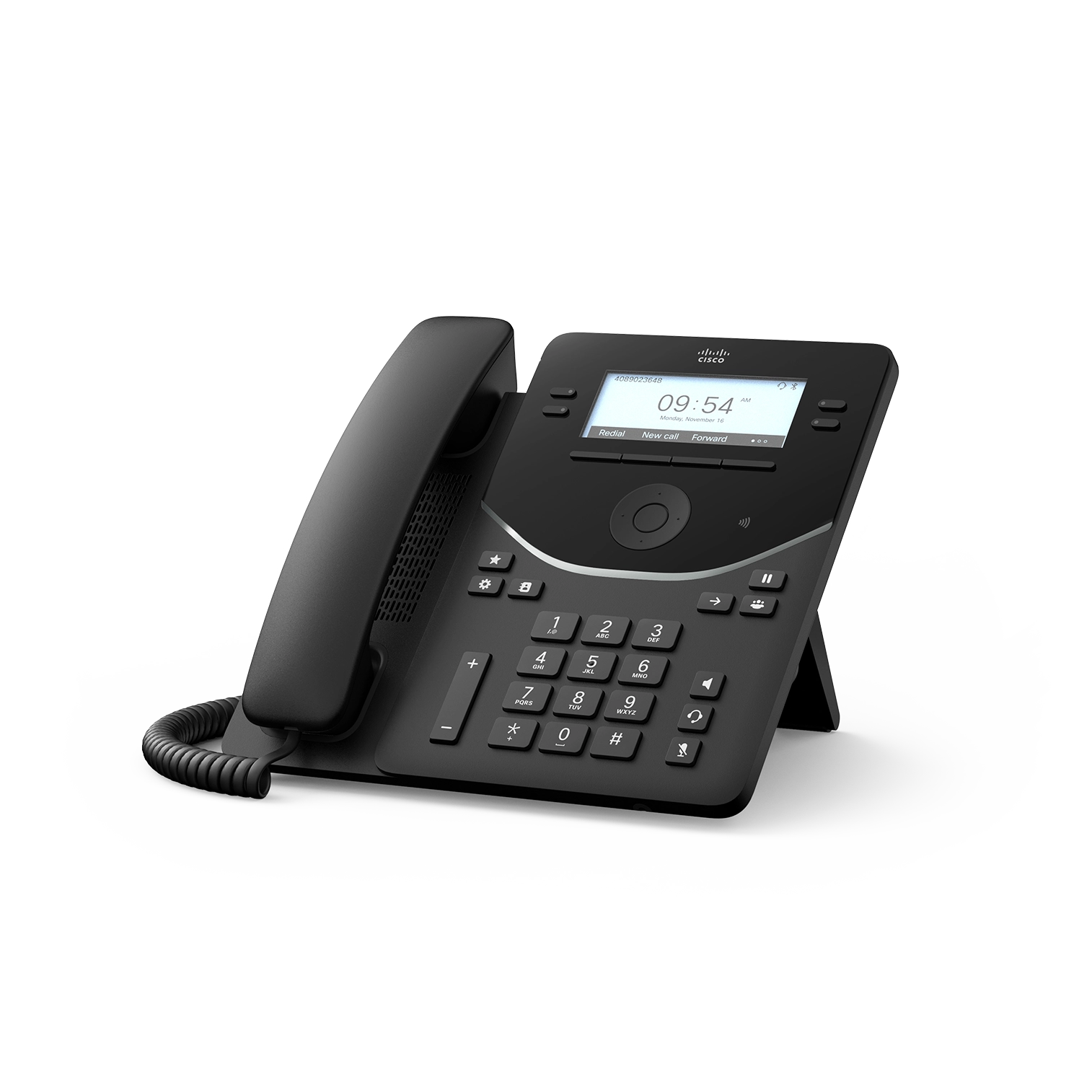
Documented specifications
Cisco · Cisco's support index lists the 9800 Series as available and includes the 9811 at review; regional stock, purchased order code, calling-platform entitlement, approved firmware and remaining support period were not established.
| Specification | Documented value |
|---|---|
| Display | 2.6-inch backlit grayscale LCD, 256 × 132 Source ↗ |
| Physical controls | Two physical line keys and a maximum of two line or programmable-line keys; a customizable action button is separately documented Source ↗ |
| Ethernet | Internal two-port 10/100BASE-T switch for the phone and a co-located device Source ↗ |
| Power | IEEE PoE class 2; exact local-power accessory and deployment need confirmation Source ↗ |
| Headset and device ports | One RJ-9 headset port and one auxiliary console-output port; no USB port is listed for 9811 Source ↗ |
| Wireless onboarding | Wi-Fi and NFC onboarding are explicitly unsupported; the reviewed specifications do not assign Bluetooth to 9811 Source ↗ |
| Handset audio | A narrowband-capable handset is supplied by default; Cisco lists the wider-family wideband handset as an optional compatible accessory Source ↗ |
| Expansion | The 9800 KEM compatibility table lists 9851, 9861 and 9871, not 9811 Source ↗ |
Unlisted fields remain unverified. Platform compatibility and remaining support life require confirmation for the exact ordered model.
Use the entry model for the intended desk
Cisco introduced 9811 support with PhoneOS 4.0(1) on January 20, 2026 and describes it for branch offices, small and medium businesses or lobby spaces. That positioning is a manufacturer use case, not a capacity or suitability result. Record the exact user, call flows, line appearances, directory needs, accessibility, headset and emergency-location workflow before selecting the smaller interface.
The datasheet lists two physical line keys and at most two line or programmable-line keys. Those counts are not two SIP credentials, two concurrent calls or proof that every calling platform exposes the same line behavior. Use Cisco's current per-platform feature tables for Webex Calling, BroadWorks and Unified CM, and obtain an exact support statement for any other Open SIP deployment.
Keep the wired network and pass-through limit visible
The 9811 uses a two-port 10/100 Ethernet switch, while the reviewed datasheet assigns Gigabit switching to the larger 9841 through 9871 models. Confirm the phone VLAN, 802.1X method, LLDP-MED, DHCP or static addressing, provisioning path and the actual bandwidth requirement of any co-located device before placing its network traffic behind the phone. A link light or completed registration does not validate voice VLAN, QoS, certificate or restart behavior.
Cisco's current registration and diagnostic pages explicitly state that 9811 does not support Wi-Fi. Plan a cabled port and cable route; do not select it as a wireless fallback or infer a radio from the 9800 family name. Preserve switch port, MAC address, IP addresses, active server and hardware and software version with the deployment record.
Treat power, ports and accessories as exact-model decisions
The datasheet assigns PoE class 2 to 9811. Budget the switch for the exact phone and supported local-power option, then prove cold boot, network recovery and an approved outage procedure. Cisco documents no USB port for this model, so a USB headset, adapter or charging workflow cannot be transferred from a 9841 or larger phone.
The phone provides an RJ-9 headset port and a console-output auxiliary port. The auxiliary connector is not an analog headset or pass-through audio port. Cisco supplies a narrowband-capable handset by default and lists the family wideband handset as a separate compatible option. Record the purchased handset and headset, firmware prerequisites and remote-listener results rather than describing optional wideband hardware as carton contents.
Do not transfer KEM, Bluetooth or NFC claims from the family
The current KEM table names 9851, 9861 and 9871; it does not list 9811. Likewise, the datasheet assigns Bluetooth to the 9861 and 9871 radio models, and current onboarding documentation explicitly excludes 9811 from NFC onboarding. A family-level accessory photo, PhoneOS menu or provisioning field is not evidence that this exact hardware implements the function.
For shared coverage or monitored destinations beyond two physical keys, document the required line-state behavior and select a model and KEM combination that Cisco lists for the intended power arrangement. Do not work around a hardware boundary by publishing unsupported XML, attaching an unlisted accessory or representing a softkey workflow as a physical monitored-key substitute without user acceptance.
Pin PhoneOS and calling-platform evidence together
The current release notes separate Webex Calling, BroadWorks and Unified CM columns and show feature differences across PhoneOS 4.0, 4.1 and 5.0. Record platform, device package, PhoneOS build, onboarding method, certificates and provisioning owner as one baseline. The January 2026 release note also calls out the MIC and CA material required on the call-control system for 9811; do not replace or bypass trust inputs without Cisco's current platform procedure.
Check the current preferred and security-fixed train before deployment rather than installing the first release that introduced the model. A family certification table is manufacturer evidence, not independent VoIP.info interoperability testing. Successful registration does not prove hold, transfer, line-state, voicemail, emergency location, action-button behavior, certificate renewal or upgrade recovery.
Pilot the complete desk workflow and retain diagnostics
Pilot incoming and outgoing calls, two-way audio, mute, hold, resume, blind and attended transfer, conference, line selection, call waiting, DND, voicemail and message indication, headset behavior, directories, restart and network recovery. Verify the action button only for the configured platform purpose, including accidental activation and recovery. Use the organization's approved non-live emergency procedure and independently available fallback.
Cisco's September 2026 diagnostic guide exposes product, serial, MAC, IP, server, software, hardware, certificate and onboarding status plus a problem-report workflow. Treat logs as sensitive, time-bounded support artifacts: record the incident time, restrict access, transfer through an approved channel and remove local exports on schedule. No phone, firmware, calling platform, network, accessory, feature, emergency workflow, availability, price or live call was tested for this guide.
Sources & applicability
Primary references for the technical details above. Operational examples and planning checklists are VoIP.info editorial guidance.
- Cisco Desk Phone 9800 Series datasheet ↗
- Cisco Desk Phone 9800 Series support index ↗
- Cisco PhoneOS 9800 and 8875 release notes ↗
- Cisco: get started with Desk Phone 9800 Series ↗
- Cisco: register a PhoneOS 9800 or 8875 device ↗
- Cisco: troubleshoot 9800 and 8875 phones ↗
Examples require adaptation to your topology. No live PBX or hardware testing is claimed.