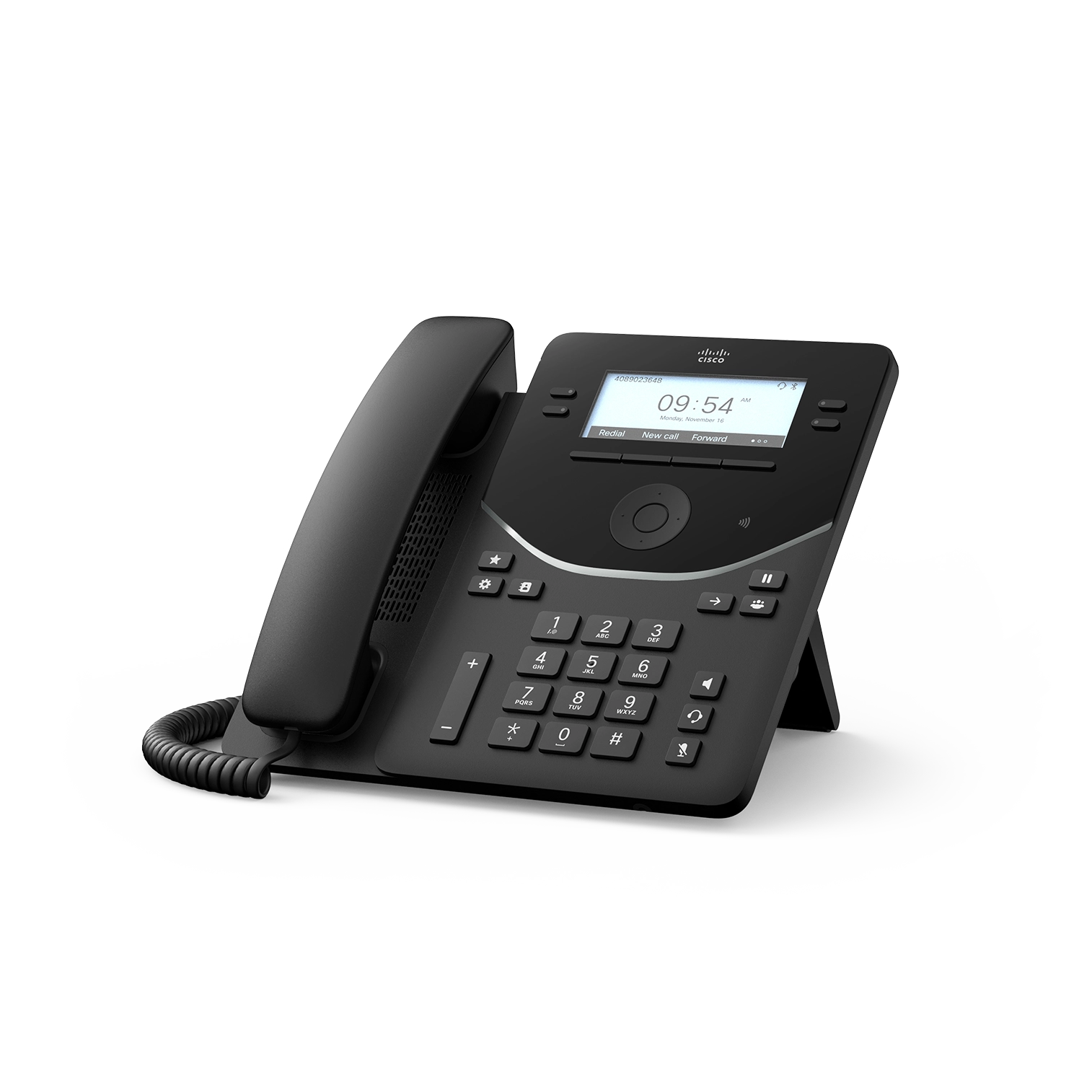
Documented specifications
Cisco · Current manufacturer catalogue evidence; future support end date not confirmed
| Specification | Documented value |
|---|---|
| Display | 3.5-inch backlit grayscale LCD, 384 × 160 Source ↗ |
| Physical line keys | 4 Source ↗ |
| Line / programmable assignments | Maximum 4 Source ↗ |
| Platform SIP-line ceiling | 130 on Unified CM / Webex Dedicated Instance; 16 on Webex Calling / Open SIP; not a concurrent-call figure Source ↗ |
| Ethernet | Two-port 10/100/1000 Ethernet switch Source ↗ |
| Power | IEEE PoE class 2; local adapter option Source ↗ |
| USB-A output | 0.25 A at 5 V (1.25 W) under PoE; 0.5 A at 5 V (2.5 W) with Cisco Power Adapter 3 Source ↗ |
| Expansion / auxiliary boundary | No listed 9800 KEM support; auxiliary port is for console logs Source ↗ |
| Wi-Fi / Bluetooth | Not listed for 9841; radio features are assigned to 9861/9871 Source ↗ |
| Codecs | Includes Opus, G.722 and G.711 Source ↗ |
Unlisted fields remain unverified. Platform compatibility and remaining support life require confirmation for the exact ordered model.
Keep keys, assignments and SIP lines separate
The 9841 is a wired candidate for a desk that values four fixed physical controls and a compact grayscale display. Cisco lists four physical line keys and a maximum of four supported line or programmable-line keys for this model. Those four assignments are distinct from the family table's platform ceilings of 130 SIP lines on Unified CM or Webex Dedicated Instance and 16 on Webex Calling or Open SIP. None of those figures establishes simultaneous-call capacity, provider entitlement or how a selected service maps identities to the four visible controls.
Preserve exact-model exclusions
Choose another model if the desk requires built-in Wi-Fi or Bluetooth, a color or touch display, more than four line or programmable assignments, or a 9800 Key Expansion Module. Cisco assigns the family radios to the 9861 and 9871 and lists KEM compatibility for the 9851, 9861 and 9871, not the 9841. The 9841 instead has a two-port Gigabit Ethernet switch, a USB-A port and an auxiliary port that Cisco documents for console logs. Do not transfer USB-C, radio or expansion claims from sibling models.
Qualify the platform and controls
Cisco lists Asterisk among the 9800-series tested and certified interoperability platforms, but says key features can vary with the registered calling platform. Record PhoneOS, PBX or service release, provisioning owner and the exact required feature list. Then pilot registration, incoming and outgoing calls, attended and blind transfer, message waiting, headset control, restart recovery and each assigned line key. A family-level certification and a configured SIP identity do not prove every feature, key state or emergency workflow on an installed release.
Power the USB load deliberately
Cisco documents USB-A output as 0.25 A at 5 V, or 1.25 W, when the phone uses PoE and 0.5 A at 5 V, or 2.5 W, with Cisco Power Adapter 3. Treat those as source-dependent port limits, not proof that a chosen headset, adapter or charging load works. Confirm the accessory's draw and control path, the phone's IEEE PoE class 2 requirement and the switch budget before rollout. The auxiliary port is a console-log path rather than general accessory power.
Firmware, security and lifecycle boundary
Treat PhoneOS selection, smart-power settings, management exposure, TLS, SRTP, 802.1X and emergency mechanisms as acceptance items rather than configured outcomes. Cisco's September 2025 advisory affected 9800-series SIP software only when Web Access was enabled, states that Web Access is disabled by default and names 3.3(1) as the first fixed 3.x release for the documented issues. Preserve that dated scope and compare the installed release with current advisories and platform release guidance. Cisco's support page currently marks the 9841 Available Order and links the March 25, 2026 datasheet; that is catalogue evidence, not regional stock, price or a promised support end date. Verify the complete SKU, power accessory, service agreement and calling-platform entitlement. No VoIP.info hardware testing is claimed.
Sources & applicability
Primary references for the technical details above. Operational examples and planning checklists are VoIP.info editorial guidance.