Documented specifications
Yealink · A current Yealink product page and a November 25, 2025 manufacturer datasheet were available at review; exact regional SKU availability, hardware revision, approved base firmware, warranty entitlement and remaining support period were not established.
| Specification | Documented value |
|---|---|
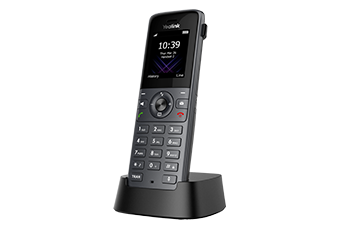
| Display | 1.8-inch 128 × 160 TFT colour screen Source ↗ |
| Call boundary | Up to 2 simultaneous calls per handset; account, base and system limits remain separate Source ↗ |
| Audio | HD audio, full-duplex speakerphone, FNR/noise cancellation and HAC are listed capabilities Source ↗ |
| Headsets | Bluetooth 5.1 and 3.5 mm wired headset connections are listed Source ↗ |
| Alerts | Vibration plus voicemail and missed-call notification light are listed Source ↗ |
| Published battery figures | Up to 24 hours talk and 320 hours standby in ideal conditions; ten-minute charge for two hours talk Source ↗ |
| Hardware-revision boundary | Datasheet identifies different battery construction for V0–V3 and V4 Source ↗ |
| Published base compatibility | W70B single-cell and W75B/W80B/W90B multi-cell bases are listed Source ↗ |
| DECT bands | Separate Europe, US, Thailand and Brazil frequency ranges are listed Source ↗ |
| Environmental rating | No ingress or drop rating is stated in the reviewed records; use an explicitly rugged model where the risk assessment requires one Source ↗ |
Unlisted fields remain unverified. Platform compatibility and remaining support life require confirmation for the exact ordered model.
Bind the handset to an exact base system and region
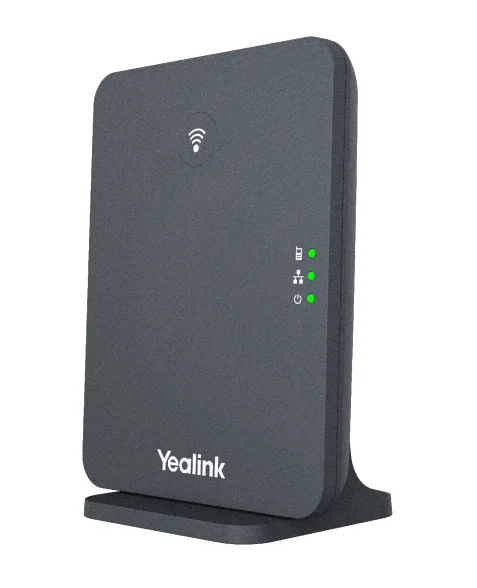
The W74H is a handset, not a SIP base. Yealink lists W70B for single-cell use and W75B, W80B and W90B for multi-cell systems. Record the handset hardware revision, regional DECT band, base or manager system, firmware pair, PBX profile and assigned user. Compatibility on a product page is not proof that every feature, accessory and firmware combination is supported by the chosen service.
Use the W75 mini multi-cell reference when the deployment needs up to three planned radio cells. Use the W90 reference for the larger managed system. Independent single-cell bases do not become one roaming system merely because the handset can register to that model family.
Keep handset, base and account limits distinct
The datasheet lists up to two simultaneous calls per handset. It also describes the W74P pairing with W70B as a larger system with its own handset, account and call totals, while W75 has different system and per-base boundaries. A user, handset, SIP account, registered contact, radio call and trunk channel are not interchangeable counts.
Map how the PBX assigns identity and features to the base system and how the handset selects a line. Confirm inbound alerting, outbound identity, hold, transfer, three-way conference, DTMF, MWI and directory behavior with the actual platform before rollout.
Treat Bluetooth and wired audio as separate paths
Yealink lists Bluetooth 5.1 and a 3.5 mm headset jack. Confirm the exact headset, pairing owner, call-control support, audio routing and reconnect behavior for each path. A Bluetooth pairing icon does not prove microphone selection, remote answer/end control, mute synchronization or recovery after the handset returns to its charger.
Test handset receiver, speakerphone, wired headset and approved Bluetooth headset separately with a willing caller. Check transmit, receive, mute, volume, alerting and handoff. Keep HAC and noise-reduction listings as device capabilities rather than promises of intelligibility in every workplace.
Measure the shift instead of adopting battery maxima
The published twenty-four-hour talk and 320-hour standby figures are explicitly ideal-condition values. The datasheet also distinguishes V0–V3 and V4 battery construction even though it repeats the same headline endurance. Record the hardware revision, battery age, charger and approved replacement part.
Pilot the actual shift pattern with signal level, roaming, display, vibration, Bluetooth use, speakerphone and call load. Define low-battery alerts, charging ownership, spare-handset procedure and replacement threshold. A ten-minute quick-charge claim does not remove the need for a full-shift recovery plan.
Do not extend office positioning into rugged approval
The reviewed W74H records describe a compact business handset, vibration, belt clip and broad operating temperature, but they do not state an IP ingress or drop rating. Do not infer water, dust, chemical, cleaning or fall protection from appearance or from another Yealink model. Use the W59R or another exact rugged handset when the assessed hazard requires documented protection.
Complete an occupied-area range and roaming test with the selected base system, then verify provisioning, directory, firmware update and lost-device revocation. No W74H, base, PBX, headset, battery, charger, radio path, roaming event, protected session, availability, compatibility, price or live call was inspected or tested for this reference.
A registered W74H still needs call and roaming evidence
Registration does not prove every stationary call, radio cell, handover or media direction. Use the focused Yealink DECT diagnostic to compare the exact base system, firmware, serving cell, PBX response and two-way audio.
Sources & applicability
Primary references for the technical details above. Operational examples and planning checklists are VoIP.info editorial guidance.
- Yealink W74H product page ↗
- Yealink W74H datasheet ↗
- Yealink W75 product page ↗
- Yealink W75 datasheet ↗
- Yealink W90 product page ↗
- Yealink W90 datasheet ↗
Examples require adaptation to your topology. No live PBX or hardware testing is claimed.